Pages

Monday, July 18, 2016

Amanuensis Monday: A LETTER TO UNCLE JOHN

Genea-Musings:

The following is from Randy 
Seaver's blog:

Genea-blogger John Newmark started a blog theme called Amanuensis Monday and offers this definition:


A person employed to write what another dictates or to copy what has been written by another.


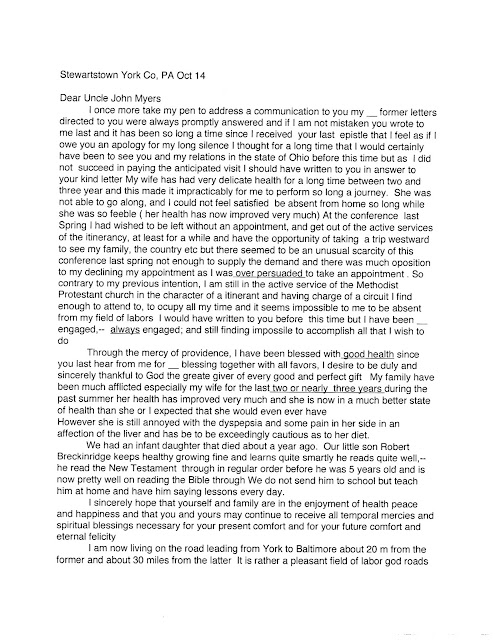
The following is a letter to John Myers in Darke County, Ohio from his nephew James M. Elderdice who writes from Stewartstown, York County, PA October 14 @1847.
The letter is included in .tiff format followed by a Word transcription:

NOTES:  Fellow researcher on the Myers surname Elizabeth Duncan sent me this letter and others belonging to John Myers and his uncles.

(The Reverand) John Myers was the GGGG Uncle of my husband Jeffrey M. Lott.

John Myers can be located in the 1850 census at http://www.rootsweb.com/~usgenweb/oh/darke/census/1850
(current as of 1998).

Information from the John Myers letter:


* John Myers was the maternal uncle of John M. Elderdice.

* John Myers is in the active service of the Methodist Protestant Church in the character of an itinerant (New Market circuit).

* His wife is ill and has had dyspepsia but health is better.

* An infant daughter died a year ago.

* Our cousin Henry Myers has returned from his excursion of 20 western states on a reconnoitering expedition.

"in this part of the country the people are not much disposed to immigrate westward..."

* I now live on a road leading from York to Baltimore 20m from the former and 30m from the latter.

* Crops of grain are good.

* James reports a considerable number of children deaths from dysentery in Pennsylvania.

* The last two paragraphs end much as with a sermon..." to cultivate Christian love...we are laboring and hoping for better times Paul may plant and Apollos may water but God gives the increase[sic].

* It closes with greetings from James' wife with remembrances and love to all and to direct your letter to Stewartstown, York Co. PA.




Other Myer letters, wills, and documents follow in future posts. 


See ya down the road...


Wednesday, July 13, 2016

Ya Gotta Get It Together - Part One

Getting Organized—Part One

This blog will be referring to the July/August Family Tree  article by Denise Levenick, "The End of the Paper Trail" and how I have applied the guidance of this article to organizing my own genealogy paperwork.


"When your genealogy paperwork isn't organized, neither is your research," Denise Levenick says.

It is that time in my life when  "stuff," all kinds of stuff, needs to be released, streamlined thinned out, thrown out. 

BUT.... Genealogy papers, books, photos and all kinds of epherma were not on my list to be thinned out until I read the article by Denise Levenick in Family Tree magazine. 

I can do this! 
Denise Levenick inspiringly said, "Not paperless, but less paper."

This process is multileveled so when organizing be prepared to
jump from computer, to files, to bookshelves, to in-basket 
and back again.

It is like rearranging furniture...one move leads to other smaller moves or projects or areas with which to deal.

Step One was to look at the files on my computer. Too many to tackle all at once. So I did a basic rearranging of: surname folders. I was organizing to get ready for organization.


See Denise's Article and Step 8 following suggested organized, detailed folder structure. 

BUT I had files in scanning folders, photo folders, email folders 
EVERYWHERE.

I will haveto return and organize folders surnames, photos, general genealogy, and more. 


(See? It is like rearranging furniture!)


Step Two was to look at the overflowing folder of paper in the form of journal articles, speakers handouts, pages torn from conference syllabi, yellow pages of handwritten notes, and what is in my in basket. 


Family files in the file cabinet are next.  This will be an continuation of Step 8 of Levenick's article.

Most of the paperwork in the folder was tossed into the recycle. Others were scanned.


Cute story: In this in basket I found a handout from Denise from when she spoke to the San Diego Genealogical Society about this very same topic. I loved the quote she included on her handout from Hercule Poirot,
"...the world it is drowning in paper."


(For Scanning See: Ya Gotta Get It Together - Part 2

Regarding Research Logs: Religiously I kept a print out of my research logs (see photo above) even though I had passed the goal(s) reflected on them. 
For example: I kept all the Berlin research log information in addition to the letters and replies (See Grandmother Born in Berlin? blog). These are no longer needed. Think LESS Paper. 

This is just the beginning... as refining your folders will go on and on.

Step Three is the preparation for scanning of heirloom documents. I have had success here. 

MY original documents have already been scanned. So I am ahead here.
MY originals are in acid free binders. 

 BUT COPIES OF ORIGINALS 
need to be scanned and these 
copies of originals put in the recycle.

Note: You should use a flatbed to scan delicate heirloom documents or use a camera and take a photo of the heirloom.
 Key words here: BE CAREFUL when handling heirloom documents.
------------------------------------------------------------------------------

* Blog: Grandmother Born in Berlin

* "The End of the Paper Trail" by Denise Levenick July/August Family Tree magazine

* Speaker's notes: Denise Levenick The Paper-Less Genealogist Organizing Your Genealogy With Digital Files

Are you in the process of organizing? 
I would love to hear from you.

See ya down the road...

Wednesday, July 6, 2016

Grandmother Born in Berlin, Germany ?

A BERLIN BRICKWALL

My maternal grandmother, Anna Marie Binder, was my brick wall from the beginning of my genealogical research. Document after document  that I had in my possession stated country of origin Germany or Berlin.

Church document in San Diego. Information provided by Anna.

Year, YEARS of research in Berlin archives and locations referred to by Berlin Archives involved postal mail, postage, international postal certificates, weeks of waitiing for replies and then further translations.

Below are addresses in Berlin or German Genealogical archives between the years 1997 and 2004.

Staasbibbliothek Zu Berlin
D-10102 Berlin
Unter Den Linden 8
D 10117

Standesamt 1 in Berlin

Senatsverwaltung fur Innes
Fehrbelliner Platz 1
10702 Berlin

Evangelisches Zentralarchiv in Berlin
Jebebasstrasse 3 106 Berlin

Sachsisches Staatsaarchiv Leipsig
Deutche Zentr4alstelle fur Genealogie
Schonnenstrasse
04329 Leipsig

Hauptstaatsarchiv Stuttgart
Konrad Adenauer Str. 4
70173 Stuttgart

Thuringisches Hauptstaatsarchiv Weimar
D 99423 Weimar
Marstallstrasse 2


I provide these address here for anyone who may need to research Berlin, Germany.

In another post you will read how I determined that Berlin was not the location of my grandmother's birth.


Monday, June 27, 2016

PART TWO of WE THREE and our story


Ron, Diane and Anna 

Continued... A Brief 

Family History of the Berger and Binder Surnames.


Catherine Binder was born in what was Yugoslavia (now Palesnik/Hercegovac, Croatia) but her mother Anna Marie and the Binders were born in Hungary and believed also to have emigrated prior to the 1700’s  from Germany as Donube Swabians. 

Germans were recruited to come into the Hungary to help rebuild the country after the Turks laid it waste. The Binders can be traced back to mid 1700s in Somogy Harsagy, Hungary .
LDS micfrofilm

Anna Marie Binder (Bauer) was born in Somogy Harsagy, Hungary as was her father Johan (Ivan, John). She was the only living birth of Johan Binder and Agnes Marie Weingartner. Agnes was listed as native of Switzerland on Anna's death certificate.  Agnes Marie died (?) and Johan remarried Marianna Bauman (Baumann).
LDS microfilm

Of that union there were Kata (Aunt Katie), Ivan (uncle John) who came to America and Teresa Binder Bauer, and Elizabeth Binder Rebic. Of these who remained in Europe I have visited the daughter (Teresia) of Teresa Binder Holowitz (who lives outside Munich) and the grandson (Franjo) of Elizabeth Binder Rebic (who lives in Zagreb, Croatia).
LDS microfilm,  family group sheets of Estella Bacon

Johan Binder (Anna’s father) visited America and at least in 1910 was on the South Dakota census as a hired man. He made several trips to and from America but no other family members followed.
Ree Heights, South Dakota census of 1910

Anna Bauer moved to Ree Heights South Dakota where she married Winfield Scott Bauer.
Marriage certificate of Polo Catholic church document

Kata (Aunt Katie, my half great aunt) came to America registered on the ship as Binder and married Matias Muehl at Ellis Island. 
Ellis Island and passenger list documents

Kata was pregnant at the time. They moved to Reblake, WI. From there they went to South Dakota and then to New York state. Anna Binder and her daughter Kata (my mother) came to America in about 1910. It is believed that at any one time they were all in the same place Reblake, WI or Mitchell, SD as there was a family photo* taken of Johan, Katie, Matt Muehl, little Kata, and two of Katie’s other children (Mathew and John?). Kata Muehl’s first child Anton died at birth in Reblake, WI.
Census records, death record, church records

*The photo then had three of Johan’s children in it (Ivan/John, Katie and Anna).

DNA results of our lineage has been somewhat stunted as not many Eastern Europeans of the Bergers or Szabos are here in America. And of those that may be in the USA it is supposed have not many take the DNA tests.

From the DNA samples from Ronnie and David Berger the DNA reveals a not so surprising German ancestry but also and surprisingly French ancestry as well. 

If you are Danube Swabian I would like to hear from you.

See ya down the road... on the horizon...


Thursday, June 23, 2016

Travel on the Danube


Danube Swabians or Donauschwaben


The continued study of Eastern European family history is based on the study of geography and political changes and history of Europe itself. 


The Binder family of my mother and the Berger family of my father were Danube-Swabians from Germany.
http://www.dvhh.org/slavonia/esterreicher.htm
Research of birthplaces for the Bergers reflects a second great grandmother had a German birthplace and the Binder dates of birth, marriage, and death going 1) back to the early 18th century in Hungary 2) with Binder not being an Hungarian surname, and 3) the location of Binder family in Hungary being an area needing population by Germans. 
postal research, Eastern European researcher, LDS microfilm

First, A Bit of History
In the 17th century the Turks were defeated outside Vienna. Their occupation and defense of this Danube basin for many years  caused devestation of land and people. Following the defeat they retreated from the area. This left a great area in the Danube basin  and the Banat needing repopulation and development. 

Germans were encouraged to repopulate the area. The Hungarians enticed Germans from the Swabia area in the basin and Banat with the promise of very few restrictions on their religion, culture, and language.
See any good history, geography of the Balkans.


Danube-Swabians travelled the Danube in small boats symbolized here.
And thus the name Danube-Swabians was given to the many Germans of the Swabia areas of Germany (lumped together with tens of thousands from other areas). Many of these came from Ulm, Germany by boat down the Danube. The boat symbolized above.

This repopulation and migration occurred in three waves named for the monarch who sponsored their migration.  

See Tafferner's book cited below.

Small Towns in Northern Hungary

While visiting Hungary in 2016, I was taken to a several small town in the northern part Hungary along the Danube populated by the decendents of Danube Swabians.
Notice the similarity of this boat
to the symbolized boat above

In one of their parks was a statue dedicated to the German Swabians who travelled by boat to the areas populated during those migrations.

Although I did not understand much of the lecture of Swabians history and their population of this area, what was later translated for me went along with what I had read and with my research.


Research of birthplaces for the Bergers reflects a two great grandmother with a Ersingen, Thueringen, Germany birthplace. (translated information from baptismal record of the Roman Catholic Parish in Timisora, Romania) 
The Binder dates of birth, marriage, and death go back to the early 18th century in Hungary on microfilm. 
(LDS microfilm # 2065210 and 2065211)


And this research goes along with my continued query as to:
What nationality am I?
The country where I was born? California
I am a Californian.
The country where my parents were born? Hungary
I am Hungarian.
Or
The country from whence my family came? Germany
I am German.

AND THE RESEARCH GOES ON....next DNA.

__________________________________________________

* Tafferner, Anton, Schmidt, Joseph and Senz, Josef Volkmar, The Danaube Swabians in the Pannonia Basin, a ne German Ethnic Group, S and M Rotogravure Service, Inc New Berlin, Wisconsin, 1982.

*Koehler, Eve Eckertm, Seven Susannahs: Daughters of the Danube

* History of the Danube Swabians,  lecture 2016.


See ya down the road,

If you have Danube Swabian in your family history I would love to hear from you.


Copyright @ 2015-16 Diane McClure Lott
ALL RIGHTS RESERVED. NO USE WITHOUT PERMISSION


Saturday, June 18, 2016

PART ONE of WE THREE and our story


Recently at the request of my brother Ron I wrote a brief history of the 
Berger/Szabo and Binder families.
This is our  story.
Part One is presented here.
Diane, Anna and Ronald
Diane, Ronald and Anna


It is odd that Leo Berger and Catherine Binder met in San Diego, CA when as it were they were born not so far away from each other in Austria Hungary. It is less than a day’s drive by car from Palesnik, Croatia where Catherine Binder was born to Temesvar, Romania where Leo Berger was born.

Leo Berger was born in Temesvar, (now Romania) Hungary when the area belonged to Hungary but tracing Leo’s roots his great grandmother was from Germany and the Szabos are yet to be researched whereas Berger certainly is a German name and Szabo is certainly an Hungarian name.
Aranka Aurelia Szabo, Leo’s mother, was born in the south of what is now Romania in Buzias/Bazias. Being so the record of her birth was located just across the border in what is Serbia.

I have had an Eastern European researcher investigating the Berger/Szabo line in Hungary, Romania and Serbia. I have the documents of birth for Leo, Etelka (Etta) and Aranka Aurelia and the death records of Aranka's husband Lipot Berger.

There are believed to be Szabo’s still in Romania or Eastern Europe but I have not followed up on them yet.

Grandmother Aranka Aurelia Szabo Berger (Larsen) came to America following an uncle who lived San Diego. Aranka Berger and her son Leo came directly to San Diego. Etta (Etelka) who married Joseph Mattias Prihoda remained in Budapest, Hungary until their son Bela Leo was born and then came to San Diego.

99% of this is information is sourced with confidence.

Part Two is to follow in another blog.

Are you Hungarian and do you have stories to share? I would loce to read them.

See ya down the road.


Thursday, March 10, 2016

Facial Recognition??

  A LOOK AT TWO SETS OF PHOTOS

After reading Maureen Taylor's, the Photo Detective, e-newsletters, blogs and information on her website I can make some photo comparisons.

But the ones below still baffle me.

* There is no information written on the back of the photo.

* The person who sent these photos to me had no information.

* I have sent these to distant relations in Canada who might be able to give me a lead.

What is your thinking?

 FIRST SET OF PHOTOS:
Is the lady in the single photo below also in the group photo?

* Is she seated first row left?
OR
* Is she standing in the second row left holding the baby?
OR 
* Not in the picture at all?


My guess is the woman in the back row holding the child. Of course at a different time in her life.


SECOND SET OF PHOTOS:
Is the man centrally seated in the group shot above also seated centrally in the group shot below?
My guess is that the man seated centrally in the first photo is the same  man maybe 50+ years later in the second photo.

*And to put a "krimp" in your thinking/analyzing, is one of the middle aged women in the second group photo the child in the arms of the woman in the first group photo?


What is your thinking?
If you have any thoughts please reply to my post and thank you.
 

See ya down the road,